Bleeding may become sudden and severe.
Chapter7
Assessment foundations
Obstetric History and Terminology
Educational use onlyThis chapter supports certification preparation and clinical reasoning. Follow local policy, scope of practice, medical direction, and the established obstetric record.
Learning objectives
After completing this chapter, you should be able to interpret obstetric terminology, calculate GTPAL accurately, determine how gestational dating was established, recognize history patterns that change transport risk, and communicate uncertainty without inventing clinical details.

The transport history must answer
1
What is happening now?
Symptoms, maternal status, fetal status, urgency.
2
How far along?
Documented gestational age, EDD, dating source.
3
What can recur?
Prior hemorrhage, preterm birth, hypertension, surgery.
4
What capability is needed?
Obstetric surgery, blood, anesthesia, neonatal care.
Mother–fetus connectionA history item may affect two patients. Gestational age predicts neonatal vulnerability; maternal hemorrhage and prior uterine surgery influence both maternal perfusion and fetal oxygen delivery.
Opening transport scenario
A 32-year-old patient at a documented 33 5/7 weeks’ gestation is being transferred for painless vaginal bleeding. The referral note lists G4P2103, placenta previa, one prior cesarean birth, Rh-negative blood type, and an unknown group B Streptococcus result. She reports a prior postpartum hemorrhage requiring transfusion.
Raises concern for abnormal placental adherence when previa is present.
Supports early hemorrhage readiness.
Requires appropriate neonatal capability.
The history changes equipment, vascular access, blood-product planning, destination selection, and the threshold for diversion.
1. Why obstetric history matters during transport
A focused obstetric history is not a ceremonial intake. It is a risk-prediction tool. It should clarify the present emergency, the reliability of gestational dating, the previous pregnancy story, and the resources that may be needed before arrival.
Current physiology
Bleeding, pain, contractions, membranes, fetal status, vital-sign trend.
Gestational age
Exact weeks and days, EDD, and source of dating.
Prior outcomes
Delivery mode, hemorrhage, hypertension, prematurity, neonatal course.
Capability needs
Blood, surgery, anesthesia, maternal subspecialty, and neonatal level.
Clinical trapDo not complete a long history before treating active hemorrhage, seizure, airway failure, shock, cord prolapse, imminent birth, or fetal bradycardia. Stabilize first and gather history in parallel when possible.
2. Gravida, para, and GTPAL
Gravida is the total number of pregnancies, including the current pregnancy. Para summarizes pregnancies reaching the local reporting threshold. GTPAL expands that summary into term, preterm, abortion, and living categories.
All pregnancies, including current.
Pregnancies delivered at term.
Pregnancies delivered before 37 0/7 weeks but after the reporting threshold.
Pregnancies ending before the reporting threshold.
Living children at the time of history.
Current pregnancy+1 gravida
Prior term singletonT1, L1
Prior preterm twins, both livingP1, L2
One early lossA1
Final summary: G4 T1 P1 A1 L3Twins count as one pregnancy in the T or P category but may contribute two living children. The documentation threshold is often 20 weeks, but local definitions vary and should not be treated as a universal definition of viability.
A current pregnancy follows one term singleton birth, one preterm twin birth with both twins living, and one early loss. What is the GTPAL?
Answer: G4 T1 P1 A1 L3.
3. Gestational age and estimated due date

Preferred information hierarchy
- Assisted-reproduction dating, when applicable
- First-trimester ultrasound
- Reliable LMP with consistent cycle history
- Later ultrasound
- Physical examination as supportive context
33 5/733 completed weeks + 5 days
Gestational age is conventionally measured from the first day of the last menstrual period. For a regular 28-day cycle, the estimated due date is approximately 280 days from the first day of the LMP. The established obstetric EDD should be documented early and changed only for defined reasons by the obstetric team.
Paramedic bridgeThink of gestational dating like a verified medication concentration: use the established source, document uncertainty, and do not silently substitute your own estimate.
The patient says “about 31 weeks,” but the chart says 32 6/7 weeks from a first-trimester ultrasound. What should you document?
Answer: The established chart dating and source, plus the patient’s differing statement and any clarification obtained.
4. Gestational-age categories
The last weeks of pregnancy are not physiologically interchangeable. Use the precise category rather than the generic word “term.” A pregnancy with no ultrasound confirming or revising dating before 22 0/7 weeks is considered suboptimally dated by ACOG.
5. Current-pregnancy history
Dating and fetal profile
- Gestational age, EDD, and source
- Singleton or multifetal
- Presentation and placental location
- Growth, fluid, and known anomaly
Current symptoms
- Bleeding or fluid loss
- Contractions and urge to push
- Fetal movement
- Pain, headache, dyspnea, fever
Pregnancy complications
- Hypertension or diabetes
- Placental disease
- Infection or thromboembolism
- Cardiac, respiratory, or renal disease
Treatments and records
- Medications and infusions
- Allergies
- Recent labs, ultrasound, and FHR
- Planned destination and delivery mode
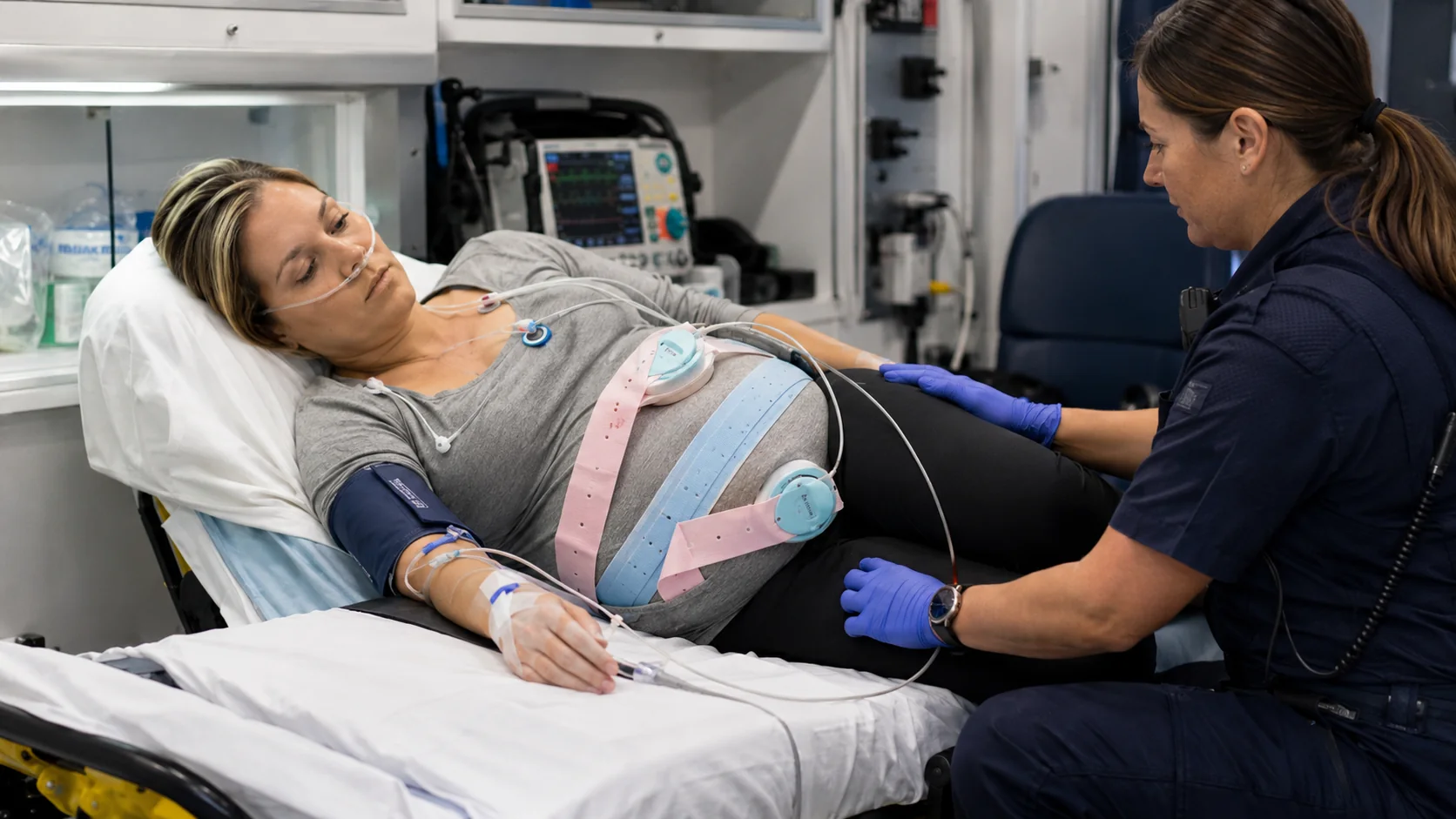
6. Prior-pregnancy history that changes transport risk
Hemorrhage
Prior PPH, transfusion, accreta, previa, abruption, retained placenta, inversion.
Hypertension
Preeclampsia, eclampsia, HELLP, pulmonary edema, stroke.
Prematurity
Spontaneous or indicated preterm birth, PPROM, cervical procedures.
Delivery complications
Shoulder dystocia, operative delivery, uterine rupture, difficult anesthesia.
Fetal and neonatal
Stillbirth, neonatal death, NICU admission, anomaly, growth restriction.
Medical complications
Diabetes, thrombosis, cardiomyopathy, severe infection, psychiatric crisis.
A parity code cannot reveal these events. Ask for the story of each clinically important pregnancy.
7. Previous cesarean delivery and uterine surgery
What you can see
Abdominal skin scar
Does not reliably identify the uterine incision.What you need to know
Low-transverse, classical, T/J extension, prior rupture, myomectomy, or other cavity-entering surgery
Obtain the operative record when possible.Transport decision pointComplete placenta previa over a prior cesarean scar should trigger early communication about placenta accreta spectrum, hemorrhage resources, anesthesia, blood bank, operative capability, and destination time.
8. Prenatal records and laboratory history
Pregnancy dating
EDD, dating ultrasound, gestational age.
Core labs
ABO/Rh, antibody screen, CBC/platelets, infectious screening.
Intrapartum infection risk
GBS result and antibiotic plan when relevant.
Imaging
Placenta, fetal number, presentation, growth, fluid, anomalies.
Fetal assessment
Most recent tracing, Doppler, biophysical testing, trajectory.
Prior operative records
Uterine incision, accreta surgery, myomectomy, complications.
Routine prenatal testing commonly includes blood type and Rh factor, antibody screening, complete blood count, urinalysis, urine culture, and infectious-disease testing. GBS screening is performed during each pregnancy because the result can affect intrapartum antibiotic planning.
9. Common obstetric terminology
10. A transport-focused interview sequence
Threats first
Stabilize bleeding, seizure, airway, shock, cord prolapse, or imminent birth.
Dating and reason
Exact GA, EDD source, transfer diagnosis, current symptoms.
Current fetal status
Movement, FHR, presentation, membranes, contractions.
Risk history
Prior surgery, hemorrhage, hypertension, prematurity, neonatal course.
Reconcile and report
Records, medications, acceptance, capability, and contingency plan.
11. Evolving case study
Phase 1: Decode the parity
The patient is recorded as G4P2103. You verify two term births, one preterm birth, no pregnancy losses, and three living children. The current pregnancy makes gravida four.
Phase 2: Identify the pattern
The ultrasound documents complete placenta previa overlying the prior cesarean scar. The patient reports prior major postpartum hemorrhage. The crew verifies large-bore access, hemorrhage supplies, blood availability, and immediate receiving capability.
Phase 3: Resolve dating conflict
The patient says “about 32 weeks,” while the prenatal record lists 33 5/7 weeks from a first-trimester ultrasound. You document the established dating and the patient’s statement; you do not replace the EDD.
Phase 4: Reassess the destination
Bleeding increases and tachycardia develops. The planned center is 40 minutes away, while a hospital with obstetric surgery, anesthesia, blood bank, and neonatal stabilization is 9 minutes away. The history supports immediate escalation and diversion discussion.
12. High-yield chapter summary
- Gravida includes the current pregnancy.
- GTPAL counts pregnancies in T, P, and A; L counts children.
- Twins are one pregnancy but may add two living children.
- Use the established obstetric EDD and dating source.
- First-trimester ultrasound is the most accurate routine ultrasound method for dating.
- Use precise gestational-age categories.
- Prior pregnancy complications alter transport readiness.
- The uterine incision matters more than the skin scar.
- Prior cesarean plus placenta previa is a major hemorrhage-risk pattern.
- Document uncertainty and conflicting sources.
- History must never delay stabilization.
References
- American College of Obstetricians and Gynecologists. Methods for Estimating the Due Date. Committee Opinion No. 700.
- American College of Obstetricians and Gynecologists. Definition of Term Pregnancy. Committee Opinion No. 579.
- American College of Obstetricians and Gynecologists. Obstetric Patient Record Forms.
- American College of Obstetricians and Gynecologists. reVITALize: Obstetrics Data Definitions.
- American College of Obstetricians and Gynecologists. Routine Tests During Pregnancy.
- American College of Obstetricians and Gynecologists. Placenta Accreta Spectrum.
- Centers for Disease Control and Prevention. Screening for Group B Streptococcus Bacteria. Updated May 2025.
- International Board of Specialty Certification. Maternal Fetal Transport Microcredential Candidate Handbook. 2026.
Chapter assessment
Twenty-question obstetric history quiz
Immediate rationales are shown in study mode, and your score is stored locally.